
下面这段《绝望的主妇》S03E08场景以一场“预设好的家庭干预”开场。Susan试图通过与Karl合作,以“好警察/坏警察”的方式来干预女儿Julie的恋爱关系。然而,这个看似结构化的管控策略很快崩溃,演变为一个多方参与的家庭博弈现场。在这里,权威、边界与道德判断不断被重新定义,问题的核心也从“约会管控”转变为“家庭权力结构的不稳定性”。
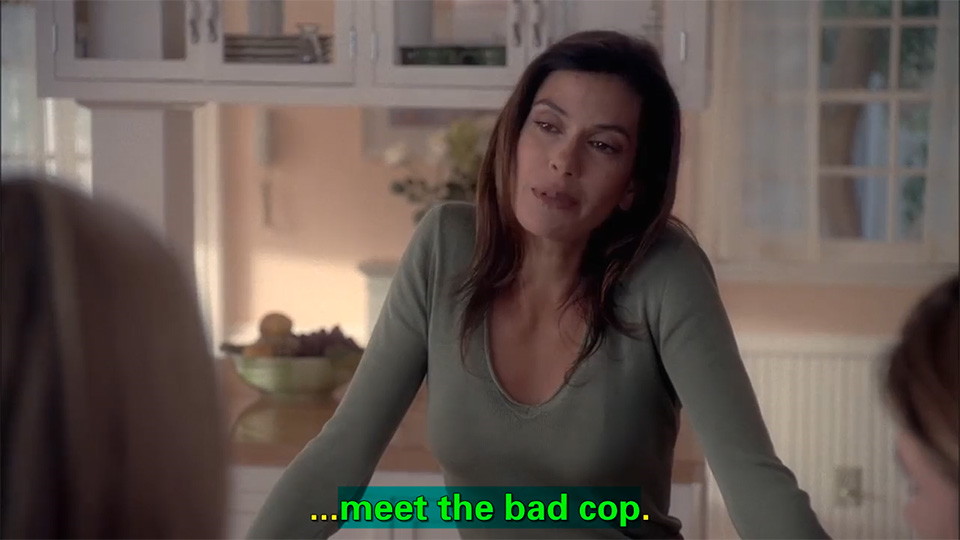
Susan: Before we begin, would either of you like some cookies, 在我们开始之前,你们有人想吃点饼干吗,
——>> milk, lemonade perhaps? 牛奶,或者柠檬水?
Julie: Mom, why are we here? 妈妈,我们为什么要来这里?
Susan: Ah. Cutting to the chase. I like it. 啊,直奔主题,我喜欢。
——>> I have a confession to make. 我有件事要坦白。
——>> This whole dating drama has been keeping me up at night. 这整件约会闹剧让我夜不能寐。
——>> And I hate being the bitchy, naggy mom. 而且我讨厌当那个唠叨又凶的妈妈。
——>> When it comes to parenting, 在育儿这件事上,
——>> I am much more comfortable playing the good cop. 我更习惯扮演“好警察”的角色。
——>> You see where I’m going with this, kids? 你们明白我的意思了吗,孩子们?
Julie: No. 不明白。
Susan: Oh. Well, in that case…meet the bad cop. 好吧,那就……见识一下“坏警察”。
Julie: Daddy. 爸爸。
Karl: Hi, baby girl. Is that the guy? 嗨,宝贝女儿,就是这个男的吗?
Susan: Yep. Get him. 对,就是他,上。
Julie: This is so unfair. 这太不公平了。
Susan: Look, you defied my wishes, you broke my rules. 听着,你违背了我的意愿,破坏了我的规矩。
——>> Did you think I was just gonna throw in the towel? 你以为我会就这么认输吗?
——>> Face it. I outsmarted you. 面对现实吧,我比你聪明。
Karl: Who’s Ian? 伊恩是谁?
Susan: What? 什么?
Karl: You’re dating some British guy named Ian. 你在和一个叫伊恩的英国人约会。
Susan: How did that come up? 你怎么知道的?
Julie’s BF: I’m sorry. I didn’t realize it was a big secret. 对不起,我不知道这是个大秘密。
Karl: When you said it was true love with you and the plumber, 当你说你和那个水管工是真爱的时候,
——>> I was a good guy. I stepped aside. 我做了个好人,我退出了。
——>> And now you’re on to someone else. 现在你又换了别人。
Susan: Big picture, Karl. His hand up our daughter’s shirt. 从大局看,卡尔,他的手在我们女儿的衣服里。
Karl: Don’t change the subject. 别转移话题。
Susan: That is the subject. 这就是话题本身。
Karl: How serious is it with this Ian guy? 你和这个伊恩到底有多认真?
Susan: I don’t know. It’s complicated. 我不知道,很复杂。
Julie: Yeah, he’s kind of married. 是啊,他有点已婚。
Karl: He’s what? 他什么?
Julie: It’s not what you think. 不是你想的那样。
Julie’s BF: In her defense, his wife is in a coma. 说句公道话,他老婆在昏迷中。
Karl: I… That’s it! All right, I forbid you to see this guy. 我……够了!我不允许你再见这个人。
Susan: What? No. I don’t take orders from you. 什么?不行。我不接受你的命令。
Julie: Mom has a point, Dad, You can’t tell a woman who she can and can’t date. 妈妈说得有道理,爸爸,你不能决定一个女人能和谁约会。
——>> It’s her choice. 这是她的选择。
Susan: Exactly. Thank you. Wait, no. That does not apply to you. 没错,谢谢你。等等,不,这对你不适用。
Karl: You know, if you don’t care about my feelings, 你知道吗,如果你根本不在乎我的感受,
——>> I don’t know what I’m doing here. 我也不知道我在这里干什么。
Susan: Your feelings? My God. You are the worst bad cop ever. 你的感受?天哪,你是史上最差的“坏警察”。
——>> Go to your room. Not you. 回你房间去。不是说你。
Introduction
This Desperate Housewives S03E08 scene stages a domestic confrontation disguised as a “controlled intervention.” Susan attempts to assert parental authority over Julie’s dating life by orchestrating a good-cop/bad-cop setup with Karl. What initially appears as a planned disciplinary strategy rapidly unravels into a multi-party negotiation where boundaries, legitimacy, and moral authority are constantly contested. The scene is less about a single dating issue and more about the instability of authority inside a blended, emotionally charged family system.
Thorough Analysis
1. Authority as performance rather than structure
Susan’s “good cop / bad cop” framing reveals that her authority is not institutional but performative. She is not relying on stable parental hierarchy; instead, she constructs a situational role-play designed to engineer compliance.
This is crucial: parenting here is treated as a tactical communication strategy, not a fixed governance structure. The problem is that such a strategy only works if all participants implicitly accept the script. Karl does not. Julie does not. The system immediately loses coherence.
Susan的“好警察/坏警察”本质上是一种角色扮演式的管教方式。她并不是依赖稳定的父母权威结构,而是通过临时策略来制造服从。问题在于,这种方式依赖一个前提:所有参与者都接受同一个“剧本”。但Karl并不接受,Julie也不接受,因此整个结构迅速失效。
2. Breakdown of alignment between adult actors
Karl enters with his own interpretive frame—he is not a recruited “bad cop,” but a stakeholder with unresolved emotional investment in Susan. His priorities are relational (jealousy, betrayal, replacement anxiety), not disciplinary.
This creates a structural failure:
- Susan: enforcing boundaries on Julie (规范Julie行为)
- Karl: demanding relational accountability from Susan (追问Susan的情感关系)
- Julie: defending autonomy and procedural fairness (主张自主权)
Instead of a parent-child dyad, the scene becomes a triangular conflict system where each node is pursuing a different objective function. 结果从“亲子结构”变成了三角冲突系统。
Karl进入场景时,并不是Susan设定的“坏警察”,而是一个仍然带有情感纠葛的前伴侣。他的关注点不是纪律,而是关系层面的情绪(被替代、被忽视、嫉妒等)。
3. Moral authority vs. procedural legitimacy / 道德权威与程序合法性的冲突
Julie’s argument—“you can’t tell a woman who she can and can’t date”—introduces a liberal autonomy principle into a situation Susan is trying to govern hierarchically.
This produces a clash between:
- Hierarchical legitimacy (Susan/Karl’s parental authority)
- Individual autonomy (Julie’s rights-based framing)
Susan’s authority weakens because she inconsistently applies principles:
- She defends Julie’s autonomy in abstract terms (agreeing with Karl’s “it’s her choice” logic when it suits her)
- She immediately retracts it when it threatens her own control
This inconsistency exposes authority as situational rather than principled.
Julie提出“你不能决定女人和谁约会”,引入了“个人自主权”的现代价值框架。这导致两种逻辑对撞:层级权威(父母管教权);个体权利(自主选择权)。Susan的矛盾在于,她在不同情境中选择性使用这两种逻辑,从而削弱了自身权威的稳定性。
4. Information asymmetry as power disruption
The revelation of “Ian” and his complicated relationship status destabilizes the entire negotiation. Importantly, Susan is not fully informed at the start, which means her control strategy is built on incomplete data.
The boyfriend’s disclosure about the wife in a coma further complicates moral evaluation. The scene demonstrates a key dynamic:
When information is partial and morally ambiguous, authority loses decisiveness.
No actor can claim clear ethical ground, so enforcement collapses into argument.
“伊恩”以及其复杂关系状态(已婚但妻子昏迷)在场景中构成信息扰动,使Susan的判断基础不完整。在信息不清晰且道德灰度极高的情况下,任何权威执行都会变得不稳定。
5. Emotional leakage and role confusion
Karl’s line—“I was a good guy. I stepped aside”—reveals that he is emotionally entangled in Susan’s romantic life. This shifts the scene from parenting into unresolved relational history.
As a result:
- Susan is simultaneously mother and ex-partner mediator
- Karl is simultaneously father figure and competing romantic subject
- Julie becomes both child and ideological challenger
The roles overlap, producing what can be described as identity interference in authority roles.
Karl的发言暴露出他仍深度卷入Susan的情感生活,使他无法纯粹作为“坏警察”。因此出现角色重叠:Susan:母亲 + 前伴侣关系管理者、Karl:父亲 + 情感竞争者、Julie:孩子 + 价值体系挑战者,这导致权威结构发生“身份干扰”。
6. The collapse of “bad cop” credibility
Susan’s final judgment—“You are the worst bad cop ever”—is not just humor; it is structural diagnosis. Karl fails as “bad cop” because he cannot detach emotional grievance from disciplinary function.
In other words:
Authority cannot be delegated when it is emotionally compromised.
The “cop” metaphor fails because policing requires impersonality, while Karl operates from personal injury.
Susan最后说“你是史上最差的坏警察”,本质上是结构性判断:Karl无法将情绪与执行分离,因此无法承担“执行权威”的角色。换句话说:当权威被情绪污染时,它无法被外包或分工。
欧文点评:该场景的核心讽刺在于:Susan试图用一个简化的权威模型(角色分工)来管理复杂的家庭关系系统,但现实中的家庭结构并不是层级机器,而是一个持续协商的情感网络。她假设权威可以被“分配与执行”,但实际上,在混合家庭结构中,权威始终依赖三种持续变化的因素:情感信誉、信息完整度,以及关系历史。该场景最终提出的问题不是“谁对谁错”,而是:当每个参与者同时在多个冲突身份中运作时,权威还能否成立?
The central irony of the scene is that Susan attempts to impose order through a simplified authority model, but the real system she is managing is not hierarchical—it is relational, fragmented, and emotionally interdependent.
Her strategy assumes that authority can be modularized (assign roles, execute discipline). The reality is that in blended family systems, authority is not assigned—it is continuously negotiated through emotional credibility, informational control, and relational history.
The question the scene implicitly raises is not “who is right,” but: Can authority survive when every participant is simultaneously a stakeholder in multiple, conflicting roles?