看美剧《绝望的主妇》学英语:Lynette VS Bree

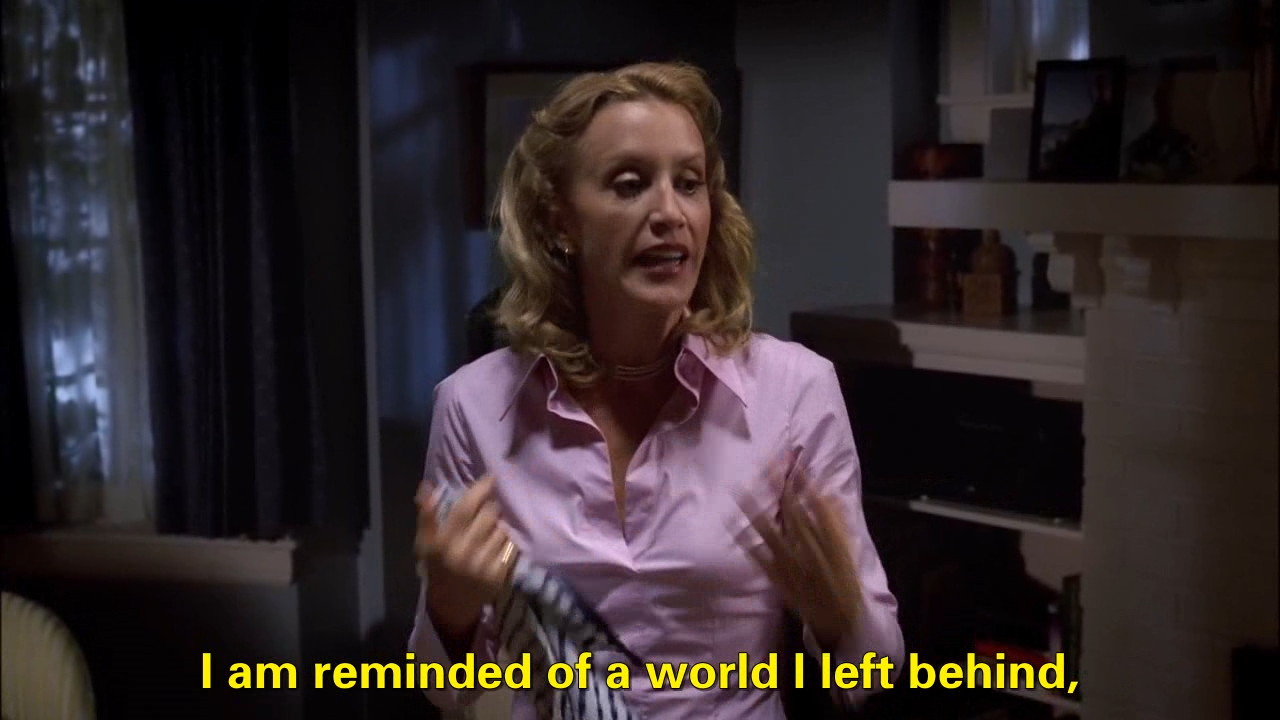
《绝望的主妇》第一季第十八集里,Lynette和Bree之间爆发了一场看似关于育儿、实则关于人性的冲突。Bree帮忙照看孩子,期间因为Porter不守规矩,打了他的屁股。Lynette得知后当场翻脸。乍看之下,这似乎是一场关于体罚的争论:别人家的孩子能不能打?但真正高明的编剧从来不会把戏停留在事件本身。因为所有精彩的冲突都有一个共同特点——表面的问题只是入口,隐藏的问题才是核心。Porter只是导火索,真正被点燃的,是两个女人内心最脆弱的部分。
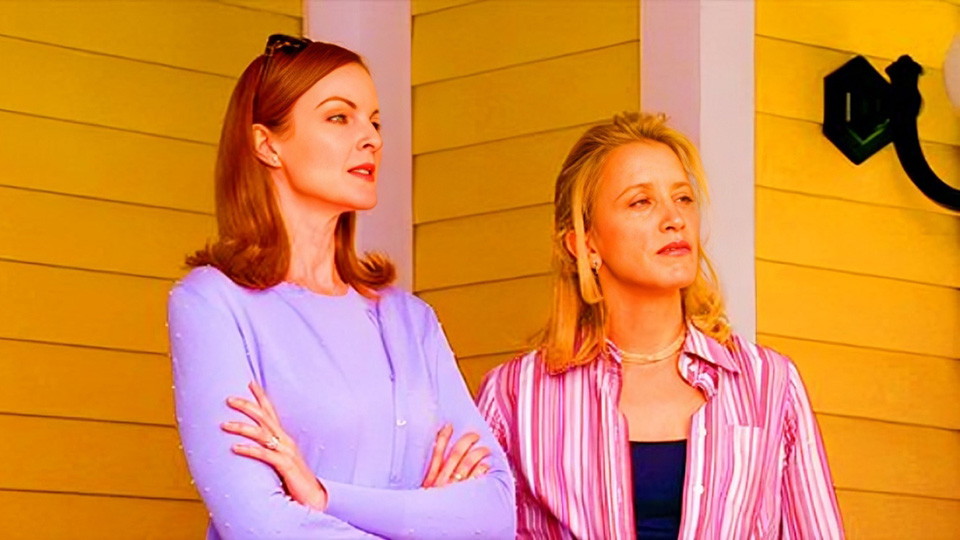
Bree: What’s going on? 有什么事吗
Lynette: My babysitter cancelled. 保姆放我鸽子
Bree: Lynette, I’m so swamped today. 勒奈特 我今天真是乱成一团
——> My house is a mess and I’ve got millions of errands to run. 家里乱七八糟 还有好多事得做
Lynette: Please hear me out. This is important. 先听我说完 这事很重要
——> Today, I have a chance to rejoin the human race for a few hours. 今天我有个回归社会的机会,就几个小时
——> There are actual adults waiting for me with Margaritas. 已经有人端着鸡尾酒在等我了
——> Look, I’m in a dress. I have make-up on. 瞧 我穿了裙子 还化了妆
Bree: If it were any other day. 可今天真的不行
Lynette: Oh, for god’s sakes, Bree, I’m wearing pantyhose. 看在上帝面上 布里 我还穿了连裤袜
Bree: Bring them in. 让他们进来吧
Lynette: Thank you, thank you 非常感谢
——> Ok, in you go. 你们进去吧
Bree: We had a wonderful time. 我们过得很开心
——> Although I think Porter had a little less fun. 不过 波特可能不太开心
——> Ok, I’ll bet. 好了 我下注了
Lynette: What do you mean, Porter had less fun? 波特玩得不尽兴是什么意思
Bree: He misbehaved, so I had to punish him. 他不听话 所以我惩罚了他
Lynette: When you say punishment, what exactly are we talking about? 你所谓的惩罚 具体指什么
Bree: Oh, I had to spank him. 我打了他的屁股
Lynette: You spanked my son? 你居然打我儿子的屁股
Bree: Lynette, is there a problem? 这有什么问题吗 勒奈特
Lynette: Tom and I don’t believe in hitting our kids. 汤姆和我从不打小孩
Bree: Sorry, I didn’t know. 抱歉 我真的不知道 ——> It won’t happen again. 不会再发生了
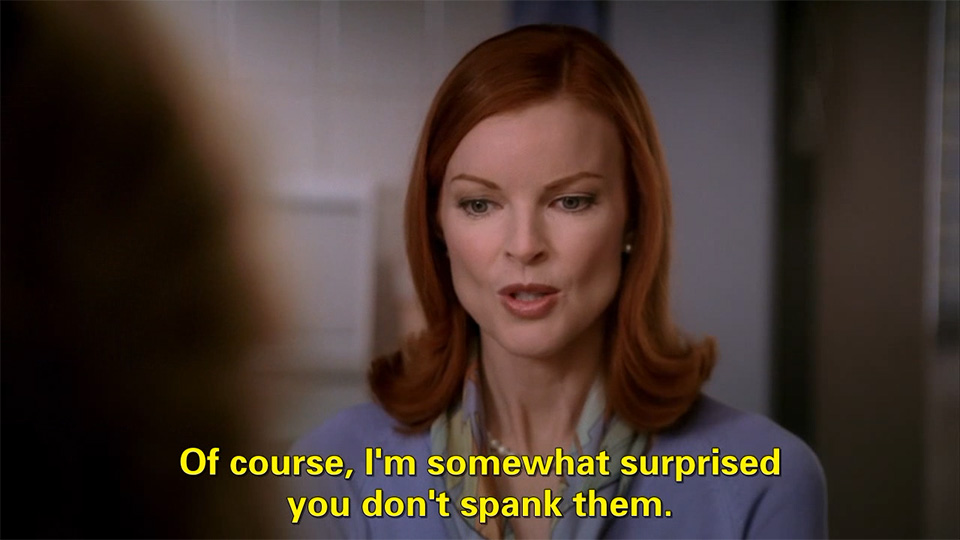
——> Of course, I’m somewhat surprised you don’t spank them. 不过你居然都不打他们 让我很吃惊
——> Everybody knows they’re a little bit… 大家都知道 小孩子有时会 ——> out of control. 过于顽皮
Lynette: Yeah, you’re right, Bree. 没错 布里
——> I’ve got a lot to learn about parenting. 在教育孩子的问题上我还有很多要学
——> I feel so blessed to be getting sage advice 能从你这样贤惠的母亲身上
——> from an impeccable mother like you. 学到东西 我感到很荣幸
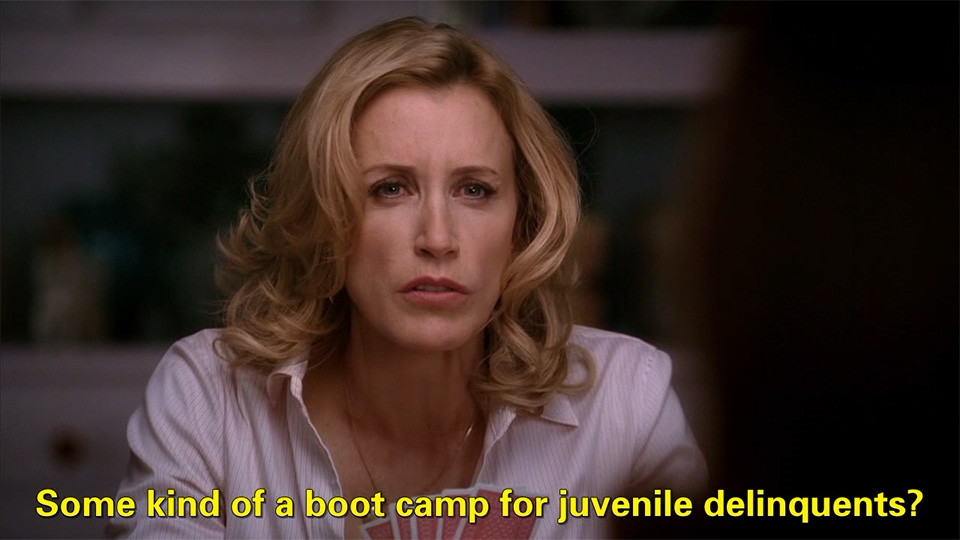
——> Your kids turned out perfect, if you don’t count Andrew. 除了安德鲁 你的孩子都很完美
——> Where is he, again? Some kind of a boot camp for juvenile delinquents? 不 他到底去哪了 会是在少年犯劳教所吧
Bree: I never said I was perfect. 我从来没说过我是完美的
Gaby: Honey, nobody’s blaming you. 亲爱的 没有人责怪你
Lynette: The hell I’m not. 我就是在责怪她
Susan: Lynette… 勒奈特
Bree: If you will excuse me. 不好意思 失陪了
Gaby: Lynette, will you go after her? 勒奈特你不去追她回来吗
Lynette: She spanked my son. 她打我儿子
——> I’m not apologizing. 我不会去道歉的
One of the most fascinating conflicts in Desperate Housewives Season 1 Episode 18 appears, at first glance, to be about parenting. Bree watches Lynette’s children, Porter misbehaves, Bree spanks him, and Lynette explodes. Simple enough. Yet the best dramas never revolve around the event itself. They revolve around what the event awakens beneath the surface. Porter is merely the spark. The real fuel is insecurity. Every memorable conflict follows the same pattern: the visible issue is rarely the actual issue.
如果单论事件本身,我更倾向于Lynette。教育方式可以有分歧,但边界必须被尊重。无论你是否赞同体罚,都不意味着你有权替别人做决定。Bree的问题不在于她相信打屁股有效,而在于她默认自己的标准可以适用于别人的家庭。然而真正让矛盾失控的,却不是这一巴掌,而是她后面那句轻描淡写的话:“Everybody knows they’re a little bit out of control.”大家都知道,你那几个孩子有点失控。很多人听到的是一句评价孩子的话,而Lynette听到的却是另一层意思:你的孩子之所以失控,是因为你这个母亲失职。从这一刻开始,她们争论的已经不再是Porter,而是彼此的价值感。
On the surface, I side with Lynette. Parenting methods may differ, but boundaries matter. Whether one believes in spanking or not is beside the point. The problem is not Bree’s belief in discipline. The problem is her assumption that her standards automatically apply to someone else’s family. Yet what truly transforms the disagreement into a confrontation is not the spanking itself. It is the sentence that follows: “Everybody knows they’re a little bit out of control.” Most people hear a comment about children. Lynette hears a judgment about motherhood. And from that moment forward, the argument ceases to be about Porter. It becomes a struggle over identity.
人类的很多争吵都遵循同一种逻辑。第一句话谈事实,第二句话谈身份。事实很少伤人,身份才会。你迟到了,这是事实;你不重视我,这是身份判断。房间很乱,这是事实;你是个失败的成年人,这是身份判断。孩子难管,这是事实;你不是个好母亲,这是身份判断。人们通常不会为事实愤怒,人们会为事实背后的意义愤怒。一句话之所以伤人,从来不是因为它说了什么,而是因为它唤醒了什么。
Human conflict often follows a remarkably predictable pattern. The first sentence addresses facts. The second addresses identity. Facts rarely wound people; identity does. “You were late” is a fact. “You don’t respect me” is an identity judgment. “The room is messy” is a fact. “You are irresponsible” is an identity judgment. “Your children are difficult” is a fact. “You are a bad mother” is an identity judgment. People are rarely offended by facts; they are offended by the meanings attached to those facts. A sentence hurts not because of what it says, but because of what it awakens.
而恰恰在这一点上,《绝望的主妇》比很多家庭剧高明得多。因为Lynette之所以失控,不是因为Bree说错了,而是因为Bree碰到了她最害怕的地方。纵观整部剧,Lynette最大的焦虑从来不是孩子太闹,而是她总觉得自己做得不够好。她曾经是广告界的明星,是别人拼命追赶的对象;如今却被四个孩子折腾得筋疲力尽。她知道自己的家不像Bree家那样整洁,知道自己的孩子不像Bree的孩子那样守规矩,也知道自己永远不可能成为那种把生活过成样板房的人。所以当Bree说“失控”的时候,她听见的不是评价,而是判决。
That is precisely why this scene is so powerful. Lynette does not lose control because Bree is wrong. She loses control because Bree accidentally touches the wound she already carries. Throughout the series, Lynette’s greatest fear is not that her children are difficult. It is that she may not be doing enough. She was once a star in the professional world, someone others struggled to keep up with. Now she spends her days battling chaos, exhaustion, and self-doubt. Meanwhile, Bree appears to embody effortless competence. Her home is immaculate. Her routines are flawless. Her life looks organized enough to belong in a magazine. Thus when Bree says “out of control,” Lynette hears not a description but a verdict.
于是她立刻反击,而且一击致命。
“Your kids turned out perfect, if you don’t count Andrew.”
除了Andrew,你的孩子当然都很完美。
这句话的厉害之处在于,它根本不是为了讲道理,而是为了制造疼痛。因为Andrew恰恰是Bree最不愿面对的失败。一个关于Porter的争论,最后却伤到了Andrew;一个关于教育方式的话题,最后却变成了人格审判。为什么?因为绝大多数冲突都不会停留在表层。夫妻为了牙膏盖争吵,最后争的是尊重;朋友为了钱翻脸,最后争的是信任;同事为了方案针锋相对,最后争的是价值感。所有激烈的冲突,表面都在争对错,深处都在争“我是谁”。
The brilliance of the line lies in the fact that it is not designed to persuade. It is designed to hurt. Andrew represents Bree’s deepest vulnerability. A conversation about Porter suddenly becomes an attack involving Andrew. A disagreement about discipline becomes a trial of character. Why? Because conflicts rarely remain on the surface. Couples argue about dishes and end up arguing about respect. Friends argue about money and end up arguing about trust. Colleagues argue about ideas and end up arguing about value. Most intense conflicts appear to be about being right. Deep down, they are about protecting a sense of self.
很多人以为自己是在捍卫观点,其实是在捍卫自尊;以为自己是在维护原则,其实是在维护身份。因为身份一旦受到威胁,人就会本能地反击。Lynette害怕自己不是一个好母亲,Bree害怕自己不是一个完美母亲。请注意这两者的区别。前者害怕失败,后者害怕瑕疵。前者渴望认可,后者渴望无懈可击。一个活在混乱的压力里,一个活在完美的牢笼里。她们看似不同,其实是同一种焦虑的两种形态。有些人被缺陷折磨,有些人被完美折磨。
Many people believe they are defending principles when they are actually defending self-worth. Lynette fears she is not a good mother. Bree fears she is not a perfect mother. Those fears sound similar, but they are profoundly different. One fears failure. The other fears imperfection. One seeks validation. The other seeks invulnerability. One lives under the pressure of chaos. The other lives inside the prison of perfection. Some people are haunted by their flaws. Others are haunted by their inability to tolerate flaws.
这也是为什么我越来越觉得,这场戏最值得讨论的根本不是育儿,而是冒犯。人为什么会被冒犯?因为冒犯本质上不是别人对我们做了什么,而是别人触碰了我们自己都不愿触碰的部分。Lynette知道自己的孩子难管;Bree知道自己的家庭并不完美。正因为她们知道,所以才会疼。**世界上最锋利的刀,从来不是陌生人的攻击,而是别人说出了自己早已知道的真相。**如果一句评价能够轻易击垮一个人,那么真正击垮他的往往不是评价本身,而是评价背后那个尚未和解的自己。
That is why I increasingly believe this scene is not fundamentally about parenting. It is about offense. Why are people offended? Because offense is rarely caused by what others reveal. It is caused by what we already know but have not accepted. Lynette knows her children are difficult. Bree knows her family is imperfect. The truth hurts precisely because it is already familiar. The sharpest knife is not a stranger’s criticism; it is someone else speaking a truth we have spent years trying to outrun. If a comment has the power to destroy us, it is often because there is already an unresolved conflict within us waiting to be exposed.
所以重看这一段戏,我越来越觉得Lynette和Bree其实是一面镜子的两侧。Lynette羡慕Bree的秩序,Bree羡慕Lynette的温度。Lynette的家像森林,杂乱、拥挤、枝叶疯长,却充满生命力;Bree的家像钟表,精准、优雅、一丝不苟,却常常失去温度。一个代表生命,一个代表控制;一个代表真实,一个代表体面。讽刺的是,她们都把对方拥有的东西当成答案,却没有意识到对方也在羡慕自己拥有的东西。人最大的错觉之一,就是总觉得别人拥有的恰好是自己缺少的。
Viewed this way, Lynette and Bree become mirror images. Lynette envies Bree’s order. Bree envies Lynette’s warmth. Lynette’s home resembles a forest—messy, crowded, unpredictable, but alive. Bree’s home resembles a clock—precise, elegant, beautiful, yet often emotionally restrained. One represents vitality. The other represents control. One represents authenticity. The other represents perfection. Ironically, each woman treats the other’s strength as the answer to her own dissatisfaction. One of life’s great illusions is believing that what someone else possesses is exactly what we need.
如果一定要问我站在哪一边,我会说,在事件层面我站Lynette,在人性层面我站两个人之外。因为真正值得思考的,从来不是谁对谁错,而是为什么每个人都如此需要证明自己是对的。很多成年人终其一生都在进行一场隐秘的辩护。他们努力工作,是为了证明自己有价值;拼命成功,是为了证明自己的选择没错;不断比较,是为了证明自己没有输给别人。可问题在于,当一个人把自我价值建立在证明之上,他就会永远活在审判之下。别人一句无心的话,都可能成为压垮情绪的最后一根稻草。
If I must choose a side, I stand with Lynette regarding the event itself. But on a human level, I stand outside the argument altogether. The more interesting question is not who is right. It is why human beings feel such a desperate need to be right. Many adults spend their lives conducting a silent defense of themselves. They work harder to prove their worth. They compare themselves to prove they have not fallen behind. They chase success to prove their choices were justified. Yet the moment self-worth becomes dependent on proof, life turns into a courtroom. Every careless remark becomes evidence.
所以这场戏真正让我着迷的地方在于,它揭示了一个关于成熟的悖论。年轻的时候,我们总想成为正确的人;成熟以后,我们才发现,比正确更重要的是理解。**成长不是越来越会反驳别人,而是越来越能理解别人为什么会这样想。**因为每个人都站在自己的山顶看风景,每个人都以为自己看见的是真相,可实际上,我们看到的往往只是角度。认知的边界,常常比世界的边界更狭窄。
Perhaps that is the deepest lesson of the scene. When we are young, we strive to be correct. As we mature, we discover that understanding matters more than correctness. Growth is not learning how to defeat opposing views; it is learning why those views make sense to the people who hold them. Everyone stands on a different mountaintop, looking at a different horizon. What we call truth is often perspective in disguise. The limits of our understanding are often far narrower than the limits of reality itself.
也许人与人之间最高级的善意,不是认同,不是赞美,甚至不是帮助,而是允许。允许别人按照自己的方式生活,允许别人用自己无法理解的方法去爱,允许别人跌跌撞撞地成长,也允许自己不必成为任何人的标准答案。因为人生从来不是一道只有唯一解的数学题,而是一篇开放式作文。有人写成长诗,有人写寓言;有人字迹工整,有人涂涂改改。重要的从来不是格式统一,而是真诚落笔。
And perhaps the highest form of kindness is not agreement, admiration, or even assistance. It is permission. Permission for others to live differently, love differently, fail differently, and grow differently. Life is not a mathematical equation with a single correct answer. It is an open-ended composition. Some write poems. Some write novels. Some leave unfinished drafts. The goal is not uniformity but honesty.
而当我们终于能够放下证明、放下比较、放下评判的时候,也许才会明白一个简单却珍贵的事实:人与人之间最遥远的距离,不是意见不同,而是总想把自己的答案变成别人的答案;人与人之间最深刻的理解,也不是观点一致,而是明知不同,依然允许。
And when we finally stop proving, comparing, and judging, we may discover something profoundly simple: the greatest distance between two people is not disagreement—it is the desire to turn one’s answer into everyone else’s answer; and the deepest form of understanding is not agreement—it is the willingness to allow difference to exist.
此处内容需要权限查看