
前言:记得中学的时候,我填报中专志愿,我对公安这个职业很向往,填报第一志愿为:荆沙市公安卫校,家里的大人过来帮我参谋的,没有一个人知道这所学校是湖北一个叫做公安县的卫校(没文化真的很可怕!),而我自己也就15岁左右的年纪,更是懵懂无知的一匹,学校录用了,尽管没去,转读了高中,但是这个事件对我的人生产生了巨大的影响。如果我那里能够遇到张雪峰老师,也许我的人生将会是绝然不同的一番景象。
I.
There is a special kind of exhaustion that comes from telling the truth for a living. It is not the fatigue of physical labor, nor the drain of intellectual effort alone. It is the slow, creeping awareness that the more faithfully you serve your audience, the more they demand—and the more the machine that carries your voice begins to grind down the one who speaks.
Zhang Xuefeng was such a voice. He rose from the railway towns of Heilongjiang to the center of China’s educational discourse by doing one thing that the industry had long avoided: he told ordinary families the truth. Which majors led to jobs, which universities delivered returns, which romanticized paths ended in debt and disappointment. It was brutal, it was reductive, and it was precisely what millions needed to hear.

He was, by any measure, a conscientious broadcaster. He believed his words carried weight, and he refused to let that weight be light.
And yet, here is the cruel arithmetic of our age: for the conscientious broadcaster, traffic and lifespan exist in inverse proportion. The more you care, the more you produce. The more you produce, the more the algorithm rewards you. The more it rewards you, the more your audience expects. And the more they expect, the less of yourself remains.
Unless, of course, you are without conscience, then you can coast, you can recycle, you can sleep like a baby. But Zhang could not. He had seen poverty from the inside. He knew that for the families watching, a wrong choice was not an abstraction—it was a decade of their only child’s life, gone. So he kept going. And the machine kept feeding.
II.
Let us name what happened to him, because naming is the first step toward understanding.
He did not die from overwork. He died inside a system where no one was paid to care whether he was alive.
Consider the actors in this tragedy. The platform needs content—it is not malicious, only algorithmic, blind to the difference between a heartbeat and a server ping. The team needs performance—their mortgages, their children’s tuition, their own futures depend on the continued output of the one at the center. The audience needs connection—millions had woven his voice into the fabric of their most consequential decisions., and their attachment, however warm, was also a demand.
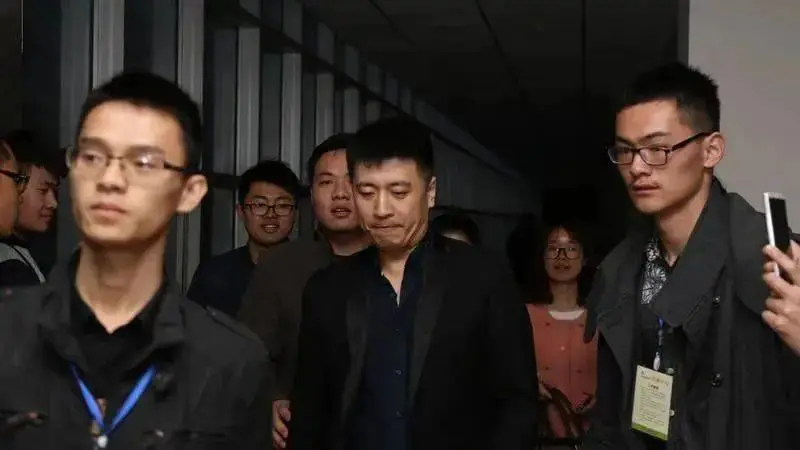
And Zhang himself—what did he need? Not money. His wealth was already sufficient to guarantee his family comfort for generations. What he needed was something harder to name: the stage, the validation, the sense of being essential. Having risen from nothing, having been booed off stages in his youth, having fought for every scrap of recognition—he could not simply stop. The spotlight had become oxygen. And the spotlight does not ask whether you are tired; it only asks whether you are still standing in it.
Each of these actors operated within the bounds of reason. No one was cruel. No one intended harm. And yet, taken together, they formed a machine that consumed a man’s life while everyone watched, and no one noticed until it was too late.
This is the nature of systemic exploitation: it requires no villain. It requires only that everyone do what seems reasonable, and that no one take responsibility for the whole.
III.
There is a moment in every meteoric career when the brakes disappear. Not because anyone removed them, but because the momentum itself becomes the driver.
Zhang reached that moment somewhere around 2023. His books sold in the hundreds of thousands. His consulting services, priced at nearly twenty thousand yuan for the premium tiers, sold out months in advance. Public appointments followed: representative in the Suzhou Municipal People’s Congress, investment ambassador for Linqing City. The accolades accumulated. The demands multiplied.
At the peak, you cannot stop. Not because you don’t want to, but because stopping would look like failure. It would look like retreat. It would look, to a man who had spent his entire life climbing, like falling.
So he kept climbing. And the higher he climbed, the thinner the air became, and the harder it was to hear the signals his body was sending. (House of cards: The higher up the mountain, the more treacherous the path. ) The heart palpitations in 2023 that landed him in the hospital. The doctor’s orders to rest. The quiet moments when his chest tightened and he told himself it was nothing.
He ran in his final month. Seventy-two kilometers in March. A 7-kilometer run two days before he collapsed. He thought he was getting stronger. He was, in fact, running toward the edge.
IV.
He had no long-term plan. This is not a criticism; it is an observation, and a warning.
Zhang built an empire that could not function without his personal presence. He trained no successor. He designed no systems that could operate in his absence. He was, in the end, not the CEO of an education enterprise but the sole performer in a one-man show that had been running for years without intermission.
This is the paradox of high achievement: the more successful you become, the less control you have over your own time. Every hour is claimed. Every decision is urgent. The space for asking fundamental questions—What would it mean to stop? Who could carry this forward? What comes after? — shrinks until it disappears entirely.
He never got to sit down with his team and design a slow exit. He never got to transition from daily broadcasting to occasional commentary. He never got to look at his empire and say, “This is enough.”
Because in the system he inhabited, “enough” was not a concept. There was only [MORE].
V.
He was, in the truest sense, trapped by the platform, or in a more broad sense, by the [Vanity Fair]. Not held captive, but bound by invisible threads of reinforcement.
Every like, every share, every comment was a dopamine hit that said: keep going. Every time he paused, the algorithm punished him. Every time he rested, the numbers dipped. He learned, as all creators learn, that the system rewards one thing above all: consistency. And consistency, when you are a conscientious broadcaster, means the slow erosion of everything that is not content production.
He understood this. He once told his team that internet celebrities have only two endings: “either you stop being popular, or you stop being alive.” He laughed when he said it. He was not wrong.
VI.
He could not find the stillness to make calm arrangements or establish reasonable boundaries. This, too, was not a personal failing but a structural one.
When you are always in production, you are never in reflection. When you are always responding, you are never initiating. When you are always meeting the demands of others, you lose the capacity to set terms of your own. Zhang had built his career on being responsive—to students, to parents, to the market—and in doing so, he had surrendered the very space where sustainable decisions are made.
There is a Chinese saying: “when the vessel is full, it overturns.” Zhang’s vessel was full to overflowing with achievement, with obligation, with the relentless pressure to produce. There was no room left for the quiet work of building a life that could endure.
VII.
And so he walked, with eyes open, into his own version of The Truman Show.
For those who have seen the film, you know the shape of the tragedy: a man living inside a constructed reality, every moment broadcast, every relationship scripted, until he no longer knows where the performance ends and he begins. When Truman finally discovers the truth and attempts to escape, the show’s creator asks him: “Was anything real?”
Zhang walked into his own Truman Show with his eyes open. He knew he was performing. He understood that his persona was at least partially a construction. He knew that the system was extracting something from him in exchange for the platform it provided. But he accepted these terms because they allowed him to do what he believed was important: tell the truth.
The tragedy is that he could not find the exit. Where Truman sailed into a storm, struck the wall of his artificial sky, and walked through a door into real life, Zhang found no such door. The system that had elevated him had no exit ramp. And in the end, only death provided the escape that conscious choice could not.
(其实去年年末,有一则新闻爆出他招到封杀,如果他能停下来,未尝不是件“塞翁失马,焉知非福”的事;但他入戏太深,照单全收了那张“催命符”。)
VIII.
At the heart of this story lies a missing concept: reverence for life.
Reverence for life means recognizing that our existence is not merely a resource to be deployed, a tool to be used for achieving goals. It means acknowledging limits. It means treating one’s own life as something precious and finite—not as a commodity to be traded for influence or wealth.
Zhang treated his life as an instrument. He used it to inform, to persuade, to build, to provide. He used it so effectively that millions benefited. But in using it, he wore it down until there was nothing left.
He was, by any measure, a successful businessman. His companies were valued in the hundreds of millions. His influence extended from individual families to national policy discussions. But he was, in a deeper sense, a failed scholar. Not because he lacked intelligence or diligence—he had both in abundance—but because he never made the transition from populizer to creator.
He synthesized existing knowledge brilliantly, but he did not generate new knowledge. He explained systems, but he did not build them. He told others how to think, but he did not give himself the time to think deeply.
Money-making can wait; intellectual breakthroughs must come early. This is a hard truth for those of us in education. The marketplace rewards visibility, not depth. Content creation pays immediately; scholarship pays in currency that may never be monetized. To choose scholarship over commerce requires a kind of faith—in the value of ideas, in the possibility of lasting contribution, in the hope that truth pursued for its own sake will eventually find its audience.
Zhang never made that choice. Perhaps he never had the opportunity. Perhaps the poverty of his early years had taught him that the safe path is the only responsible path. Whatever the reason, the result was a life of extraordinary impact that nevertheless left a question hanging: what might he have contributed if he had given himself time to think rather than speak?
IX.
This question leads us to another, older voice—a voice that might have saved him if he had listened.
If Zhang Xuefeng had carefully read the family precepts of Zeng Guofan, his fate might have been very different.
Zeng Guofan (1811–1872) was one of the most influential statesmen of the late Qing dynasty, a man who rose from humble origins to become a pillar of the empire. He was also, more importantly for our purposes, a profound thinker about how to live a balanced, sustainable life in the face of immense responsibility. His family letters contain warnings that speak directly to Zhang’s situation.
On Fullness
Zeng warned: “The way of heaven is to diminish the full and increase the humble. The way of earth is to overturn the full and flow to the humble. The way of humanity is to hate the full and love the humble.”
Zhang had achieved fullness beyond what most can imagine. And yet, Zeng’s warning suggests that such fullness is inherently precarious. The universe does not permit sustained fullness without humility and restraint. Zhang never lost his common touch, but humility in tone is not the same as restraint in action. He continued to expand, to push, to fill every space—even as his body signaled that fullness had become excess.
On Seeking Deficiency
One of Zeng’s most striking concepts is qiu que (求缺)—”seeking deficiency.” He advised his family to deliberately leave room in their lives for what was lacking, to avoid the danger of complete fulfillment. He wrote: “In all human affairs, one should seek a bit of deficiency. The moment everything is perfectly filled, misfortune will arrive.”
Zhang’s life was oriented toward filling every space. His schedule allowed no room for rest. His business had no successor prepared. His identity was so thoroughly merged with his public persona that there was no “off” position. He had built a life with no deficiency, no space for imperfection or pause—and in so doing, had created conditions where the slightest disruption could bring the whole structure down.
On the Danger of Fame
Perhaps most presciently, Zeng warned: “Fame is a vessel that heaven lends to people. When one’s fame exceeds one’s substance, disaster is not far behind.”
Zhang’s fame was immense—far beyond what most scholars or educators ever achieve. And yet his “substance”—in the sense of a sustainable personal foundation, a life not dependent on continued public visibility—had not grown proportionally. He had become dependent on the very fame that Zeng warned could become a vessel for disaster.
On Knowing When to Stop
Finally, after achieving military and political success that saved the Qing dynasty from collapse, Zeng voluntarily disbanded his armies and returned to civilian life. He understood that continued power was unsustainable and that stepping back at the right moment was itself a form of wisdom.
Zhang never found such a moment. His trajectory was one of continuous expansion, with no planned conclusion. The question is not whether he could have stepped back—he certainly could have, given his wealth and influence—but whether he could have imagined stepping back as anything other than failure.
X.
Zeng Guofan’s precepts speak to a deeper truth that Zhang, for all his intelligence, seemed to miss: sustainability is its own form of success.
The vessel that does not overflow endures. The flame that does not burn too brightly lasts through the night. The life that leaves room for deficiency, for rest, for the quiet work of reflection—that life, Zeng understood, is the life that can bear fruit over decades, not merely burn out in a brilliant flash.
Zhang burned. He burned for his audience, for his team, for the families who trusted him. And the world, as it does, watched the fire and called it success, until there was nothing left to burn.
XI.
I write this not as a detached observer but as a fellow traveler. I too stand in front of cameras. I too feel the pressure of algorithms and the expectations of audiences. I too wrestle with the question of how much to give, how much to produce, how much of myself to invest in a profession that rewards intensity and punishes restraint.
文章写到这里,我的眼中是含着泪的。中国人太苦了,中国的农民苦,中国的工薪阶层苦,中国的企业家苦(平均寿命50多岁),中国有良心的主播苦(没心没肺的除外 ),中国的房奴苦上加苦!
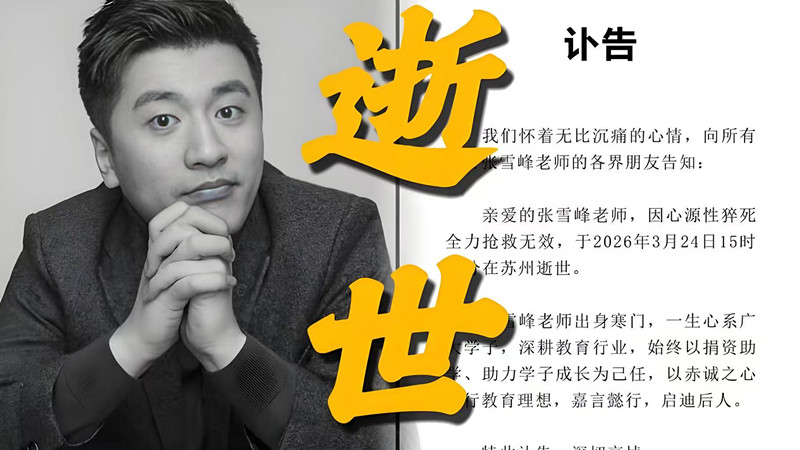
Zhang Xuefeng died at forty-one, leaving behind a fortune, a business, a family, and a legacy of having helped millions. He also left behind a warning: that the very qualities that make a conscientious broadcaster valuable—commitment to truth, sense of responsibility, refusal to compromise—can, in a system that cares nothing for human limits, become instruments of destruction.
In an age of turbulence. Learning to say “enough” is not weakness; it is the highest form of strength. And tending to the garden of one’s own soul—through reading, through reflection, through the quiet work of building something that does not depend on the approval of algorithms—is not a luxury; it is the foundation upon which everything else must be built.
May we who remain learn from his story. May we find ways to tell the truth without becoming victims of our own telling. And may we remember, in the midst of all the demands placed upon us, that we are not machines for producing content—we are human beings, with finite reserves, mortal bodies, and the right to protect our own lives as fiercely as we protect the interests of those we serve.
For in the end, the most important voice we must learn to hear is not the algorithm’s, not the audience’s, not the market’s. It is the quiet voice within that says: This is enough. You have done enough. You are enough.
Listen to it. Before it is too late.
后记:This essay was written for members of beyond learning community(绝学社), many of whom work in education, media, or related fields. It is offered as an invitation to reflect on the structures that shape our work and the choices we make within them.